|
|||||
|
The Call for Papers for the International Medieval Congress at Leeds for Summer 2011 has been posted. The theme will be “Poor . . . Rich”:
See here for the full Call for papers and panels. The CFP for the International Congress next year at Kalamazoo has now been officially published. The Lollard Society has several panels we hope to fill–please send in proposals for one of the three sessions we have on offer.
As another way to raise money, however, we have a few volumes for sale of a very hard to obtain book: The Summa de Ente, edited by S. Harrison Thomson, published by Oxford at the Clarendon Press in 1930. These were donated by a member for us to sell. We have six copies: four are in good shape, which we will sell for $25.00 each. Two have suffered from dampness on the bottoms of the front and back covers, though the text block is fine: we will sell these for $20.00 each. Costs don’t include postage at book rate (about $3.00 to the U.S.). It’s a good deal; the lowest price I see for this on Abebooks is over $50.00. And, we need the funds! You will actually buy a book to help us all out. How, then, can you not do this? You could be reading this next week! This is first come, first served, so don’t hold back. Order now. Copies will go fast . . . in fact, they’re probably going already . . . To buy one, hurry over and send a note to Jill Havens via the form on the Contact page. ![]() It is, at least, on EEBO! A number of new texts, found primarily on Google books, have been added to the Primary and Secondary Sources. Most of these are nineteenth-century biographical material on Wyclif or contemporary reviews of publications that are interesting as antiquarian curiosities. More substantially, aside from volumes described in earlier posts (Netter and the Fasciculus Rerum), all of the volumes of the De Civili Dominio are now on the site. There are also–thanks to Stephen Lahey and work by his students for this–now links to an early print and a manuscript copy of the Trialogus. What would be nice? I can’t find publicly available copies of these three important texts:
One would think that they are (centuries) out of copyright, but for some reason Google doesn’t allow any view of them at all. Since they are rare but frequently cited reference works, digital copies would be a helpful resource. A few of Wyclif’s Latin works remain oddly out of view as well, notably the Opera Minora (especially helpful because some of the shorter tracts in it were translated), the De Mandatis Divinis, and the De Ente Librorum Duorum. I’d expect to see more of these in the future as libraries digitize their collections: please send along a note if you know of any (that are free–Lyndwood and Bale, at least, can be downloaded in full from EEBO, but it’s a subscription database). A few, perhaps all, of Wilkins’ volumes seem to be available in paperback reprints on Amazon. This fit of updates has passed–other obsessions need to take over!–but of course I will correct any errors that are sent my way, and please do continue to send along to any references, new or older, that should be listed. The following studies (a few, actually not so recent) have been added to the Bibliography of Secondary Sources over the past year or so. Please get in touch with to let us know of anything else which should be added. Aziz, Jeffrey H. “Of grace and gross bodies: Falstaff, Oldcastle, and the fires of reform.” Ph.D. Dissertation, Univ. of Pittsburgh, 2007. [According to the abstract, "this dissertation recovers Shakespeare's Sir John Falstaff as a politically radical character, linked to Jack Cade and the plebian revolutionaries of 2 Henry VI , and to 16th-century radical-egalitarian movements including Anabaptism and the "Family of Love." Working from the earliest texts dealing with Sir John Oldcastle, Falstaff's historical precedent, this work explores the radical potential of reform beginning with the work of the late-14th-century Oxford theologian John Wyclif. . . . Working from Slavoj Zizek's claim that political identity is often founded on the fetishistic disavowal of a shared guilt, this work argues that the two parts of Henry IV, in their insistent metadramatic reminders of Oldcastle's treason and execution, function to disturb the audience's interpellation as subjects of Tudor-Protestant power."] Bryan, Jennifer. Looking Inward: Devotional Reading and the Private Self in Late Medieval England. Philadelphia: U of Pennsylvania Press, 2008. [Bryan creatively yokes together a range of under-examined vernacular devotional texts (the Chastizing of God's Children, The Pricking of Love, A Talking of the Love of God, the Myroure of Oure Lady and Nicholas Love's Mirror), some better-known mystical texts (Julian of Norwich's Showings--which gets a chapter--and The Cloud of Unknowing) and texts by more literary writers (Hoccleve--who also gets a chapter--and Lydgate) to examine the ways in which readers learn to understand how readers transformed "individual spiritual experience into cultural practice" (4), that is, how readers negotiate between these inward visions and their public, social selves.] Coley, David. “Baptism as Eucharist: Orthodoxy, Wycliffism, and the Sacramental Utterance in ‘Saint Erkenwald.’” Journal of English and Germanic Philology 107.3 (July 2008): 327-347. ["The article focuses on the poem "Saint Erkenwald" . . . It explores the sacrament of baptism and its association to orthodoxy, Wycliffism and sacramental utterance. Additionally, it presents the discovery of a sarcophagus containing an inexplicably preserved corpse. It also demonstrates its allegiance to orthodox eucharistic theology and the terms of its account of the judge's conversion. Moreover, it suggests how its orthodoxy is constructed through its baptismal aspects."] Cooper, Lisa. “‘Markys . . . off the Workman’: Heresy, Hagiography, and the Heavens in The Pilgrimage of the Life of Man. Lydgate Matters: Poetry and Material Culture in the Fifteenth Century. Ed. Lisa Cooper and Andrea Denny-Brown. New York: Palgrave, 2008. 89-111. [Cooper reads the Pilgrimage as an anti-Lollard critique by showing how artisans and Lollards were seen as reflections of each other.] Copeland, Rita. “Lollard Writings.” The Cambridge Companion to Medieval English Literature 1100-1500. Ed. Larry Scanlon. Cambridge: Cambridge UP, 2009. 111-123. Davis, Virginia. William Wykeham: A Life. London: Hambledon Continuum, 2007. ["Wykeham’s administrative talents ensured that he became bishop of Winchester, holder of one of the richest sees in Christendom and Chancellor of England under Edward III and Richard II. 'Everything was done by him and nothing was done without him' wrote the contemporary chronicler, Jean Froissart. . . . Virginia Davis highlights Wykeham’s extraordinarily commitment to good governance and his extensive involvement in English politics between c. 1360 – 1402."] Dotterweich, Martin Holt. “A Book for Lollands and Protestants: Murdoch Nisbet’s New Testament.” Literature and the Scottish Reformation. Ed. Crawford Gribben and David G. Mullan. Surrey, England; Ashgate; 2009. 233-245. [Nisbet's glosses show how a lay reader in the early to mid-sixteenth century negotiated between different versions of the New Testament.] Forrest, Ian. “William Swinderby and the Wycliffite Attitude to Excommunication.” Journal of Ecclesiastical History 60.2 (Apr. 2009): 246-269. [According to the abstract, "The early Wycliffite William Swinderby expressed some strong criticisms of excommunication. He was alarmed that churchman thought that it was their power, rather than God's power, that consigned a soul to hell. The rhetoric of sentences of excommunication in this period was indeed intended to frighten offenders into compliance with ecclesiastical judgements, but the theory and practice of excommunication was in fact far less simple that the Wycliffite criticism of it allowed. This article examines Swinderby's attitude towards ecclesiastical sanctions in light of Wyclif's own ideas, and the theory and practice of excommunication in the late medieval Church. Swinderby's links with early Wycliffism are elucidated and the relationship between Wycliffism and the Church is looked at in a new light."] Hornbeck, Patrick. “Antifraternalism and the Upland Series: Evidence from a Fifteenth-Century Ballad.” Notes & Queries 56.1 (Mar. 2009): 24-26. ["The article discusses antifraternalism in the 15th century ballad "Friar and Boy" about the characters Jack, the Friar Tobias, and Jack's Stepmother. According to the article, English antifraternal authors wrote about death and its aftermath, diabolical influence, and the fulfilment of biblical prophecy. The ballad also doesn't seem to come from the lollardy or Wycliffism literary movements, where lollard writers abstained from fiction and favored ecclesiastical history. An overview of the ballad is given. The article discusses if the anonymously written "Upland Series" of three texts about the fraternal orders with its characters Jack and Tobias."] Levy, Ian C. “Holy Scripture and the Quest for Authority among Three Late Medieval Masters.” Journal of Ecclesiastical History 61.1 (Jan. 2010): 40-68. [Levy discusses Gerson, Wyclif, and Netter. According to the abstract, "What separated them was not the recognition of authority as such, but rather the correct application of that authority. Wyclif exercised his rights as a university master to dissent from ecclesiastical determinations that ran contrary to the truth as revealed in Scripture. Netter and Gerson set out to curb this sort of magisterial excess which they believed would inevitably lead to the destruction of all proper norms of authority within the Church. Rather than being a simple tale of heresy and orthodoxy, therefore, this late medieval conflict turned on the question of professional expertise, rights and responsibilities."] Lewis, Anna. “Textual Borrowings, Theological Mobility, and the Lollard Pater Noster Commentary.” Philological Quarterly 88 (Winter/Spring 2009): 1-23. [Lollards adapted the content of some orthodox works, including commentaries on the basics of the faith. Of the three so-called "Lollard" commentaries on the Pater Noster, one--the longer of the two in Arnold--"combines radically Lollard complaints," but "a close look at the text reveals its strong connection to the existing commentary tradition, not only in terms of its ideas, but also in terms of its vocabulary and phrasing. If the 'lexical minutiae' found here are sometimes clearly Lollard in character, they are at other times clearly indebted to the orthodox tradition" (2).] —. “Exegesis of the End: Limitations of Lollard Apocalypticism as Revealed in a Commentary on Matthew 24.” Literature & Theology: An International Journal of Religion, Theory, and Culture 23.4 (Dec., 2009): 375-387. [Abstract: "Lollard writing is characterised by a preoccupation with the end times, but the kind of eschatological mindset the texts reflect has become a matter of some debate. This article seeks to shed some light on this issue through an analysis of the text "Of Mynystris in the Chirche," a commentary on Matthew 24 and one of the longest Lollard discussions of the Bible's eschatological prophecies. Specifically, this article points to a correspondence between a tension at the heart of Lollard attitudes to the theory and practice of scriptural exegesis and a tension at the heart of Lollard perspectives on end times events. It therefore demonstrates how this text reveals the way in which Lollard hermeneutics helped to determine the limits of Lollard apocalypticism."] Lundin, Rebecca Wilson. “Rhetorical Iconoclasm: The Heresy of Lollard Plain Style.” Rhetoric Review 27.2 (2008): 131-46. [According to Lundin, "In this essay I analyze the plain stule as conceived of and used by the Lollards. . . . I argue that the same practices that et Lollard reading and writing apart from orthodox discourse were foundational to the Lollards' departures from orthodox belief, theorizing language and style in such a way that meaning was free from priestly mediation. This demonstrates the importance of Lollard plain style as both a marker of herersy and a precursor to subsequent notions of plainness."] Lutton, Robert. “Geographies and Materialities of Piety: Reconciling Competing Narratives of Religious Change in Pre-Reformation and Reformation England.” Pieties in Transition: Religious Practices and Experiences, c.1400-1640. Ed. Robert Lutton and Elisabeth Salter. Aldershot: Ashgate, 2007. 11-39. [Lutton examines practices of popular piety, including the tolerance of Lollardy, in the Weald in Kent, notable Cranbrook and Tenterden.] Orme, Nicholas. “John Wycliffe and the Prebend of Aust.” Journal of Ecclesiastical History 61.1 (Jan. 2010): 144-152. [Abstract: "The article discusses the tenure of 14th-century English theologian and church reformer John Wycliffe as the prebend of Aust in the collegiate church of Westbury-on-Trym in Gloucestershire, England. The prebendary, one of four benefices held by Wycliffe in his life, is controversial because the economic benefit he derived from it seems to conflict with Wycliffe's reputation as a critic of the Catholic Church. Therefore, the article re-examines documents pertaining to the dates of the prebendary and the payments Wycliffe received for it." On a parallel topic see H.J. Wilkins, Was John Wyclif a Negligent Pluralist?, included on the Bibliography.] Raschko, Mary. “Common Ground for Contrasting Ideologies: The Texts and Contexts of A Short Reule of Lif.” Viator 40 (2009): 387-410. [Abstract:" This article examines the contents and manuscript contexts of the Lollard treatise 'A Schort Reule of Lif' to show how Lollards participated in mainstream religious trends and more orthodox Christians utilized a Lollard text that appealed to their common interests. 1 By providing regular times and subjects for prayer, along with advice for Christian living according to a three-estates model, 'A Schort Reule of Lif' appealed to a growing lay desire for more structured forms of devotion. The text survives in seven fifteenthcentury religious miscellanies, ranging from predominantly Lollard collections to those with primarily mainstream texts. Analysis of scribal revision, along with a new critical edition that records variation across all seven manuscripts, shows that most scribes copied the text without concern over its Lollard affiliation. Rather than reflect cautious attention to boundaries of “orthodox” belief, 'A Schort Reule of Lif' shows that common devotional interests could transcend matters of ideology."] Reid, W. Stanford. “The Lollards in Pre-Reformation Scotland.” Church History: Studies in Christianity and Culture 11.4 (Dec. 1942): 269-283. [Abstract: "The influence of the Lollard movement on the Scottish Reformation was pointed out by John Knox in the sixteenth century; and in the latter part of the nineteenth century the same point was stressed by the Historiographer Royal for Scotland, P. Hume Brown. Yet in spite of such illustrious advocacy, with one or two minor exceptions, little attention has been paid to the Wycliffite tradition in fifteenth century Scotland. It has generally been taken for granted that the Lollards were unimportant and possessed little or no influence. When all the information on the movement which we possess, however, is brought together, one cannot but feel that they had a greater influence on their own time than has heretofore been allowed: Not only did the early reformers consider them very important, but today also, in spite of predilections for economic interpretations of history, they must be regarded as one of the important sources of the Scottish Reformation."] Rice, Nicole. Lay Piety and Religious Discipline in Middle English Literature. Cambridge: Cambridge Univ. Press, 2008. [Rice examines a series of texts for religious guidance which were adapted for life outside of the cloister. She notes that at the time that these models were being developed in the later fourteenth century Wyclif was critiquing the traditional orders and "advocated a radical form of identity between lay and priestly practice" (xii). Texts she examines most closely include the Abbey of the Holy Ghost; Fervor Amoris, an adaptation of Rolle's Form of Living; The Life of Soul; Book to a Mother; and Walter Hilton's Mixed Life. Her conclusion considers several fifteenth-century manuscripts containing these works to show how later compilers envisioned the use of these texts in the wake of Arundel.] Schirmer, Elizabeth. “William Thorpe’s Narrative Theology.” Studies in the Age of Chaucer 31 (2009): 267-299. ["Thorpe's Testimony, I shall argue, sidesteps the textual strategies that had come to define both sides of the Lollard controversy. . . . In particular, Thorpe turns to narrative . . . in order to enact his intertwined theological and political projects."] —. “‘Trewe Men’: Pastoral Masculinity in Lollard Polemic.” Masculinities and Femininities in the Middle Ages and the Renaissance, ed. Fred Kiefer. Arizona Studies in the Middle Ages and the Renaissance. Turnhout, Belgium: Brepols, 2009. 117-130. [This essay argues that the Lollards engaged in a sustained retroping of marriage and sexual sin that sought to replace traditional models of clerical masculinity, grounded in ordination and signified by celibacy, with a new model of pastoral masculinity, grounded in the Word and signified by marriage.] —. “Canon Wars and Outlier Manuscripts: Gospel Harmony in the Lollard Controversy.” Huntington Library Quarterly 73 (2010): 1-36. [This essay reads the Lollard controversy as a canon war, that is, a contest between highly standardized textual programs, designed to enact opposing models of the church. It analyzes two outlier manuscripts of texts central to this canon war: Huntington Library MSS HM 501, containing Oon of Foure, and HM 149, of Nicholas Love’s Mirror of the Blessed Life of Jesus Christ. Lollard and anti-Lollard scriptural canons provided materials for innovative vernacular projects such as these, which exceed the totalizing ambitions of the controversy’s central players.] Smith, Paul. “Could the Gospel Harmony Oon of Foure Represent an Intermediate Version of the Wycliffite Bible?” Studia Neophilologica 80.2 (Dec. 2008): 160-176. ["The similarity between EV translations and OF [Oon of Foure] places the question of the harmony translator’s familiarity with the gospel versions beyond doubt; existing Bible texts must have been consulted in the making of OF. But sufficient unique characteristics of the text can be found which suggest that the work was a fresh piece of translation. . . . In order to establish the independence of the OF from existing texts it is necessary to concentrate on instances of vocabulary in OF not obviously copied from EV or LV and on aspects of the harmony in which the text is even more idiomatic than that in LV.” From an analysis of this, Smith concludes that “Oon of Foure represents an important and unique biblical version intermediate between the literalisms of EV and the modernisms of LV.”] Watson, Nicholas. “Lollardy: The Anglo-Norman Heresy?” Language and Culture in Medieval Britain: The French of England, c.1100-c.1500. Ed. Jocelyn Wogan-Browne. Woodbridge: D.S. Brewer, 2009. 334-46. [Watson deliberately echoes Hudson's article "Lollardy: the English Heresy" in his title to provoke consideration of how many popular vernacular English religious treatises are indebted to Anglo-Norman origins, as the descendants into popular religious culture of, for instance, the Somme le Roi can attest--one among many devotional, literary, and biblical texts Watson cites. Given all of this, Watson asks for further consideration of how later medieval English religious controversies descend from the translation of Anglo-Norman texts and practices.] Winstead, Karen A. “Chaucer’s Parson’s Tale and the Contours of Orthodoxy.” Chaucer Review 43.3 (2009): 239-59. [Winstead argues that "departing from the practices of contemporary penitential texts, Chaucer reduces radically both the presence of the priest in the text and the importance of oral confession in the penitential process. . . . Chaucer uses a genre whose orthodoxy would have been taken for granted by many to offer a richer, more liberal, definition of orthodoxy, recovering a tradition of penitential thought that had been elided in vernacular tracts" (240-41). In the article Winstead shows this by illustrating changes between Chaucer's tract and several contemporary works (the Way to Paradise, the Book of Penance, and the Cleansing of Man's Soul) and to his source in Pennaforte's Summa do poenitentia. She also shows how the tale's notion of penance becomes close to several other contemporary works, Julian of Norwich's Showings, Eleanor Hull's commentary on the seven penitential psalms, and the Book of Margery Kempe.] These are proposed sessions for Kalamazoo next year. Fiona Somerset is interested in hearing from people with comments or suggestions, or who might be interested in giving a paper, so please get in touch. 1) Lollard Geographies — This session invites papers on lollard writings, manuscripts bearing some relation to lollardy, or trial defendants tied to specific regions, especially when it might be possible to link those together. Papers might focus on an individual work or manuscript as it moves between locales, or on a cluster of works or ideas found in a specific area. In addition to papers focused within England, the session would explicitly invite comparative international study, or else study focused on international dissemination and exchange, perhaps tied to specific events. 2) Lollard Orthodoxies — This session continues discussion at the 2010 “Shifting Paradigms” session about how “orthodoxy” as a concept needs rethinking, especially if we view it in opposition to “heresy.” It invites papers on new ways to think about the relationship between lollard defendants or writings and “orthodoxy,” as well as papers on new ways to think about the concept of orthodoxy itself (praxis as opposed to belief, or as a reflex of belief, for example?). More broadly, papers might address any received idea (or, “orthodoxy”) in the study of lollardy that could use some rethinking. 3) Versions of the Bible — This session would invite papers on any aspect of biblical writing in late medieval England and its neighbours — we would be eager to have a paper on biblical versions in varieties of French or in germanic languages, for example. This would most centrally include the Wycliffite bible, any of its manuscripts or groups of its manuscripts, its production, use of its content in other works, other Wycliffite translations of the bible piecemeal in other writings, apparatus included with this bible, etc. But it would also invite papers on other renderings of the bible in Middle English, and on parabiblical writings and biblical scholarship. The following studies have recently been added to the Bibliography of Secondary Sources. Please get in touch to let us know of recent publications! Baker, Robin. “The Hungarian-speaking Hussites of Moldavia and Two English Episodes in their History.” Central Europe 4.1 (May 2006): 3-24. [According to the abstract, "The article considers the origin of the Hungarian-speaking Hussites in Moldavia and the factors that led to their growth, together with the nature of their beliefs. The developments that led to their eventual demise are discussed. The evidence that the prominent English Wycliffe and a leader of the Hussite movement in Bohemia, Peter Payne, stayed among them between 1440 and 1443 is also reviewed. The author concludes by exploring when the Hussites ceased to exist as a discrete cultural community in Moldavia."] —. “‘Constantine From England and the Bohemians’: Hussitism, Orthodoxy, and the End of Byzantium.” Central Europe 5.1 (May, 2007): 23-46. Knoll, Paul W. “‘The Worst Heretic’: Andrzej Gałka of Dobczyn in the Academic and Ecclesiastical Context of Mid-15th Century Krakow and Poland.” Polish Review 54.1 (2009): 3-29. ["The article discusses Andrzej Gałka, a leading faculty member at the University of Kraków in Poland and a canon of St. Florian's church in Kleparz. The author explains that Gałka was a respected scholar until he became involved with religious heresy. A history of the University of Kraków and biographical information on Gałka are included. The author talks about an ecclesiastical controversy Gałka was involved in concerning the Hussite Christian movement. Subjects of the article also include Gałka's study of the teachings of John Wyclif and letters written by Gałka."] Steuer, Jennifer. “Religiöse Strömungen der Zeit im Ackermann aus Böhmen: Johann Wiclef und sein Einfluss auf das mittelalterliche Streitgespräch.” Neophilologus 93.3 (July, 2009): 471-479. [Johannes von Tepl's dialogue between the "Ackermann" (Plowman) and death deals with such questions as the proper way of living and the relationship between men and God. This paper concentrates on the question of how far the "Ackermann"-dialogue is affected by the religious trends of the time, particularly the Pre-Reformation movement in Bohemia. The focus is on the character John Wyclif. A comparison of his theses and Johannes von Tepl's disputation demonstrates that the dialogue between the "Ackermann" and death shows Wyclif's influence. This is supported because the writer disregards the invocation of the saints and the worship of the Virgin Mary in his disputation. In addition, he uses John Wyclif's key term--the right to property--as an interpretation of the right to possess one's own life.] Vysny, Paul. “A Hussite in Scotland: The Mission of Pavel Kravař to St. Andrews in 1433.” Scottish Historical Review 82.1 (Apr. 2003): 1-19.
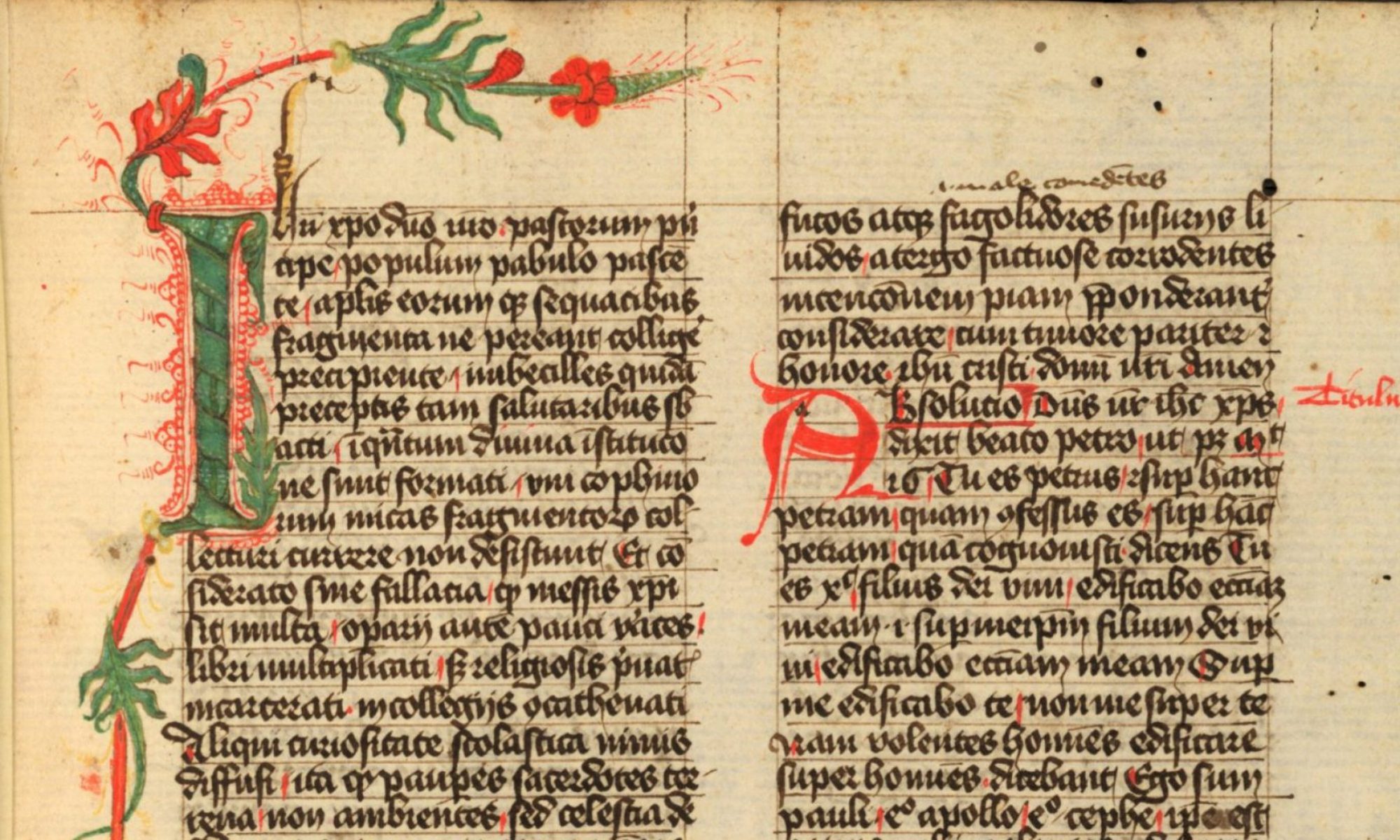
For more initial information about him and the Doctrinale see Anne Hudson, The Premature Reformation 50-55; Netter’s and Woodford’s entries in the Oxford DNB; and Kantik Ghosh’s discussion in The Wycliffite Heresy. Here is A second piece of news about Netter is that two earlier printed editions of his Doctrinale have appeared on Google Books and been added to the Bibliography of Primary Sources. Unfortunately, there are some scanning errors here, but these will be a help even so if you lack the Blanciotti edition. The first edition was printed in Salamanca in 1556-57: this printer was apparently just interested in Netter’s discussion of the sacraments, so he only published vols. 2 and 3. Vol. 2, published in 1556, is complete except for one page. The 1557 volume seems to be missing fol. 1a and is only fragmentarily scanned from fol. 265 (in cap. 152) through the end. The second edition on the website was published Venice by Jordanum Zilettum in 1571. Scanning errors here mean that two pages are missing from vol. 1 and about two dozen (every other page between fols. 254 and 278) from volume 3. Both editions are bookmarked as clearly as possible. There may be some differences among the three editions in how chapters are divided up. Note that Margaret Harvey published an essay in the new volume cited above that compares the various manuscripts and printings. Here’s a new book which came up on Google Books recently and I’ve added to the Primary Source Bibliography: the Fasciculus Rerum Expetendarum et Fugiendarum, as compiled by Edward Brown and published in London in 1690. I’ve seen older volumes like this one appear on Google over the past year or so. What Brown did was to re-print a 1535 compilation by Ortuinus (or Ortwin) Gratius (1475-1542). Gratius’ compilation is in volume 1, and Brown compiled Volume 2 as an “appendix.” According to Gratius’ entry in the Catholic Encyclopedia, this work “is a collection of sixty-six more or less weighty treatises of various authors on ecclesiastical and profane history, dogma and canon law, compiled to expose the noxious elements in the Church’s organism, and prepare a way for a future council to remedy them.” He seems to be have been a pretty bookish scholar, not very suited to public controversies in which he found himself involved. In any event, his compilation includes documents about a range of church controversies. The first three documents in Gratius’s volume, for instance, concern Martin V, Eugenius IV, and the 1435 Council of Basle. He then jumps ahead to deal with Leo X and the Reformation, and then all the way back to 11th century and Gregory VIII (formerly Hildebrand), and then even further back to Silvester II. Most of the documents in the volume, however, are from the 15th and 16th centuries, including especially William Woodforde’s condemnation of 18 points in Wyclif’s Trialogus (item 21) and material about Wycliffites and Hussites from the Council of Constance, including the documents which officially deemed Wyclif a heretic (items 22-26). One can see why Gratius was appealing to sixteenth-century protestant writers: Foxe used some of his material. Vol. 2, the Appendix, also includes material from the 11th through 15th centuries, including more material about Hus and Wyclif (items 51-56), the schism (item 48) and a copy of Fitzralph’s Defensorium Curatorum (item 44). The annual meeting of the Medieval Academy of America will be held jointly with that of MAP (the Medieval Association of the Pacific) at the Chaparral Suites Hotel (http://chaparralsuites2-px.trvlclick.com/) in Scottsdale, Arizona, 14-16 April 2011. It will be hosted by ACMRS (Arizona Center for Medieval and Renaissance Studies) at Arizona State University (ASU), Tempe. The CFP Deadline is 31 May 2010. The Program Committee invites proposals for papers on all topics and in all disciplines and periods of medieval studies. Given the Academy’s tradition of suggesting possible areas of investigation, the Committee also offers the following for your consideration: 1. Fiefs, feudal institutions, and property holding Any member of the Medieval Academy, except those who presented papers at the annual meetings of the Medieval Academy in 2009 and 2010, and any member of MAP may submit a proposal. Please do not submit more than one proposal. Sessions usually consist of three papers of thirty minutes each, and proposals should be geared to this length. The Committee may choose a different format for some sessions after the proposals have been reviewed. We shall try to develop sessions that (1) address subjects of interest to a wide range of medievalists and (2) invite scholars from different disciplines and periods into dialogue with one another. We seek proposals for innovative papers and sessions and hope to see, wherever possible, cross-disciplinary participation in a broad range of topics and of periods. Selection procedure: Proposals will be evaluated for promise of quality and significance of topic. The Committee will make final decisions by 15 September 2010. Notification of acceptance or regrets will be sent shortly thereafter. Submissions: Proposals should be submitted online at http://cf.itergateway.org/medacad/conference/ which will be available from 15 January 2010 to 31 May 2010. Note that your statement of Academy or MAP membership (or statement that your specialty would not normally involve membership in either organization) must be made at the end of your abstract. If you wish to submit a hard-copy proposal instead, please send two copies to the Committee Chair, Robert E. Bjork, Director, ACMRS, Arizona State University, Tempe, AZ 85287-4402. The proposal must consist of two parts: (1) a cover sheet containing the proposer’s name, professional status and affiliation, postal address, home and office telephone numbers, fax number (if available), e-mail address (if available), and paper title; (2) a second sheet containing the proposer’s name, paper title, 250-word abstract, statement of Academy or MAP membership (or statement that your specialty would not normally involve membership in either organization), and audio-visual equipment needs. If the proposer will be at a different address when decisions are announced in September 2010, that address should be included. Please DO NOT send proposals to the Academy office. Session proposals: The Committee will consider proposals for entire sessions. Please consult with the Committee Chair before preparing a proposal. Session proposals require the same information as individual paper proposals; abstracts for the papers in proposed sessions will be evaluated by the Committee. Audio-visual equipment: Requests for audio-visual equipment must be made with proposals. Graduate Student Prizes: The Medieval Academy will award up to seven prizes of $300 each to graduate students for papers judged meritorious by the local Committee. To be eligible for an award graduate students must, of course, be members of the Medieval Academy and, once their proposed papers have been accepted for inclusion in the program, must submit complete papers to the Committee by 10 January 2011. Program Committee: Robert E. Bjork, ACMRS (Chair); William F. Gentrup, ACMRS; Carl Berkhout, English, University of Arizona, UA; Albrecht Classen, German Studies, UA; Roger Dahood, English, UA (MAP representative); Cynthia White, Classics, UA; Alyce Jordan, Art History, Northern Arizona University; Karen Bollermann, English, ASU; Monica Green, History, ASU; Richard Newhauser, English, ASU; Catherine Saucier, Music, ASU; Corine Schleif, Art History, ASU; Juliann Vitullo, Italian, ASU; Rosalynn Voaden, English, ASU; Chauncey Wood, Adjunct Professor, ACMRS. Local Arrangements Committee: Audrey Walters, ACMRS (Chair); Robert E. Bjork, ACMRS; William F. Gentrup, ACMRS; Emilie Roy, ACMRS. |
|||||
|
Copyright © 2010 The Lollard Society - All Rights Reserved. Please contact with any questions about this site. |
|||||